
arizona commercial driver license manual
Arizona Commercial Driver License (CDL) Manual: A Comprehensive Guide
Welcome! This manual assists aspiring drivers in navigating Arizona’s CDL process, offering step-by-step guidance and crucial information for success on the road.
Embarking on a commercial driving career in Arizona requires obtaining a Commercial Driver License (CDL). This manual serves as your primary resource, detailing the requirements, processes, and knowledge necessary to operate commercial motor vehicles (CMVs) safely and legally within the state. Arizona’s CDL system aligns with federal regulations, ensuring consistent standards for driver competency and vehicle operation.
Whether you’re a new driver or transferring a CDL from another state, understanding the specific Arizona regulations is paramount. This guide will navigate you through the application process, required documentation, and the various CDL classes and endorsements available. The Arizona Department of Transportation (ADOT) oversees the CDL program, and this manual reflects their current guidelines. Remember, responsible driving is crucial for maintaining a safe transportation network throughout Arizona.

II. CDL Requirements & Eligibility
To qualify for an Arizona CDL, applicants must meet specific criteria established by the Arizona Department of Transportation (ADOT). Generally, you must be at least 18 years old to drive intrastate (within Arizona) and 21 to drive interstate (across state lines). A valid Arizona driver’s license is a prerequisite, and applicants must demonstrate proof of legal presence in the United States.
Furthermore, applicants must meet stringent medical standards, requiring a valid Medical Examiner’s Certificate (DOT physical). A clean driving record is essential; serious traffic violations can disqualify you. Background checks are also conducted to ensure public safety. Understanding these requirements beforehand streamlines the application process and increases your chances of successful CDL acquisition. Detailed eligibility information is available on the ADOT website.
III. CDL Application Process
The Arizona CDL application is a multi-stage process designed to ensure qualified drivers are on the road. It begins with completing the official ADOT CDL application form, available online or at an Arizona Driver License Service Center. Following completion, applicants must gather all required documentation, including proof of identity, residency, and medical certification.

Next, applicants will pay the necessary application fees. Once the application is submitted and approved, scheduling and passing the required knowledge and skills (road) tests are crucial. Throughout the process, maintaining accurate records and responding promptly to any ADOT requests is vital. Successful completion of all stages culminates in the issuance of your Arizona Commercial Driver License.
A. Required Documentation
Applying for an Arizona CDL necessitates a comprehensive set of documents. You’ll need proof of identity – a certified birth certificate or valid U.S. passport are common examples. Establishing residency requires two documents, such as utility bills or lease agreements, displaying your Arizona address. A valid Social Security card is also mandatory.
Furthermore, a current Medical Examiner’s Certificate (DOT physical) is essential, confirming you meet the required health standards. If you’ve held a CDL in another state, bring that license. Any relevant driving records or court documents pertaining to traffic violations must be presented. Ensure all documents are original or certified copies to avoid delays in processing your application.
B. Application Fees & Payment
Arizona CDL application fees vary depending on the class of license and any endorsements sought. As of late 2026, expect to pay a base fee for the CDL application itself, typically around $85. Each endorsement, such as hazardous materials or passenger transport, incurs an additional fee, generally in the $30-$50 range.
Payment methods accepted by the Arizona Department of Transportation (ADOT) include credit/debit cards (Visa, Mastercard, American Express), money orders, and cashier’s checks. Personal checks are generally not accepted. Fees are subject to change, so verifying the current amounts on the official ADOT website is crucial before submitting your application. Online applications often require immediate payment via credit card.
IV. Arizona CDL Classes & Endorsements
Arizona CDL classifications cater to diverse vehicle operations. Class A CDL permits operation of combination vehicles exceeding 26,001 lbs Gross Vehicle Weight Rating (GVWR), requiring substantial skill. Class B CDL is for single-unit vehicles over 26,001 lbs GVWR, or any vehicle towing a trailer under 10,000 lbs GVWR – common for buses and straight trucks. Class C CDL covers vehicles under 26,001 lbs GVWR, or those towing trailers exceeding 10,000 lbs GVWR.
Endorsements expand driving privileges. Common endorsements include Hazardous Materials (HazMat), Passenger, Tank Vehicle, and Doubles/Triples. Each requires specific testing and background checks. Obtaining the correct class and endorsements is vital for legal and safe commercial operation within Arizona.

A. Class A CDL – Combination Vehicles
A Class A CDL is Arizona’s most comprehensive license, authorizing operation of any combination vehicle with a Gross Vehicle Weight Rating (GVWR) exceeding 26,001 pounds. This includes tractor-trailers, large semi-trucks, and any vehicle pulling a trailer heavier than 10,000 pounds. Drivers must demonstrate proficiency in controlling these complex rigs, including coupling and uncoupling procedures.
Requirements for a Class A CDL are stringent, encompassing both knowledge and skills testing. Applicants must pass the general CDL knowledge test, plus a specific combination vehicles test. The skills test involves pre-trip inspection, basic control skills, and a challenging on-road driving examination. Proper training is highly recommended to ensure success.
B. Class B CDL – Straight Trucks & Buses
A Class B CDL in Arizona permits operation of single-unit vehicles with a GVWR exceeding 26,001 pounds, and any vehicle towing a trailer not exceeding 10,000 pounds. This category commonly includes straight trucks, box trucks, and large buses. It’s a versatile license for various commercial driving roles, but has limitations compared to a Class A.
Testing for a Class B CDL mirrors the Class A process, requiring a general knowledge test, and a specific test related to buses (if seeking a passenger endorsement). The skills test assesses pre-trip inspection, basic control, and on-road driving abilities, tailored to the characteristics of straight trucks and buses. Adequate training is crucial for safe operation.
C. Class C CDL – Vehicles Towing Smaller Trailers
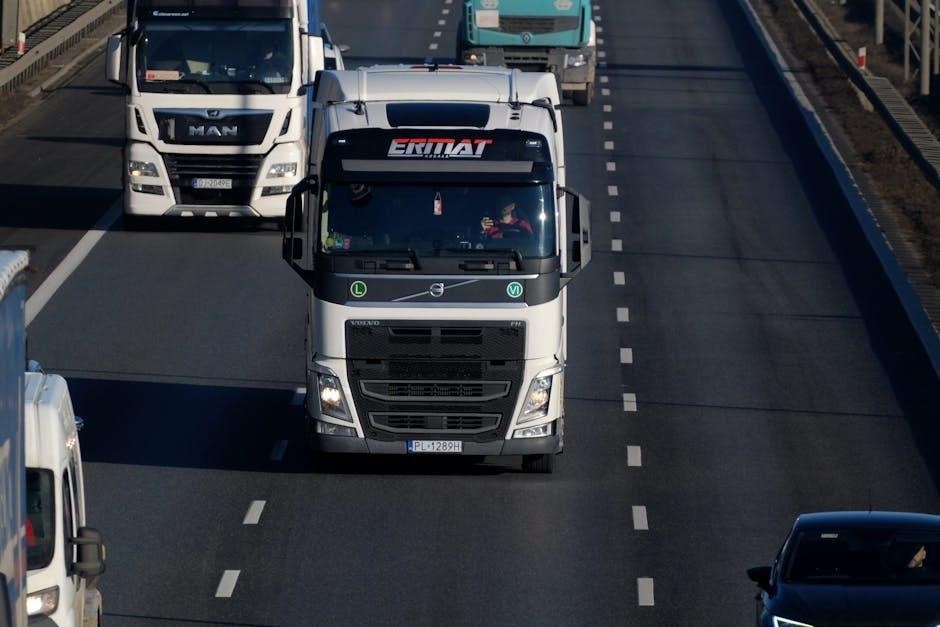
The Arizona Class C CDL is designed for drivers operating vehicles that don’t meet the definitions of Class A or B, but still require a commercial license. Specifically, it covers vehicles towing trailers with a Gross Vehicle Weight Rating (GVWR) of 10,001 pounds or more, provided the towing vehicle’s GVWR is less than 26,001 pounds.
Common examples include smaller box trucks with trailers, or passenger vehicles pulling larger equipment. Testing requirements involve the general knowledge test, and any applicable endorsement tests. The skills test focuses on safe operation of the specific vehicle combination, emphasizing proper trailer handling and securement. Proper training is vital for safe operation.
V. Knowledge Tests for Arizona CDL
Successfully passing several knowledge tests is a crucial step towards obtaining your Arizona CDL. These computer-based exams assess your understanding of essential driving regulations, safety procedures, and vehicle operation principles. The General Knowledge Test is mandatory for all applicants, covering topics like vehicle inspection, safe driving practices, and traffic laws.
Additional tests are required based on the CDL class you’re pursuing and any endorsements you seek. These include tests for Combination Vehicles, Passenger Endorsement, and Hazardous Materials Endorsement. Thorough preparation using the Arizona CDL Manual is highly recommended. Failing a test requires a re-test, with waiting periods applying.
A. General Knowledge Test
The General Knowledge Test forms the foundation of your Arizona CDL assessment, mandatory for all applicants regardless of the desired CDL class. This comprehensive exam evaluates your understanding of fundamental commercial driving principles, encompassing vital areas like vehicle inspection procedures, safe driving techniques, and adherence to Arizona traffic laws. Expect questions covering air brakes, cargo securement, and hours of service regulations.
Preparation is key; diligently study the Arizona CDL Manual, focusing on sections detailing these core concepts. The test consists of multiple-choice questions, requiring a passing score to proceed. Remember, understanding why rules exist is as important as knowing the rules themselves.
B. Combination Vehicles Test (if applicable)
For Class A CDL applicants, the Combination Vehicles Test is a crucial step, assessing your proficiency in operating tractor-trailer combinations. This exam delves into the unique challenges presented by these vehicles, including coupling and uncoupling procedures, off-tracking, and the impact of adverse conditions on handling. Expect detailed questions regarding proper braking techniques and maintaining safe distances.
Mastering these concepts requires focused study of the Arizona CDL Manual’s dedicated section. Understanding vehicle dynamics and the principles of combination vehicle control is paramount. The test evaluates your ability to anticipate potential hazards and react appropriately, ensuring safe operation on Arizona’s roadways. Thorough preparation is essential for success.
C. Passenger Endorsement Test (if applicable)
If you intend to operate vehicles designed to transport passengers – such as buses – obtaining a Passenger Endorsement is mandatory. This requires passing a specialized knowledge test focusing on passenger safety regulations and best practices. The exam covers topics like pre-trip vehicle inspections specific to passenger vehicles, loading and unloading procedures, and emergency evacuation protocols.
Expect questions regarding maintaining order and assisting passengers with disabilities, adhering to ADA guidelines. Understanding driver responsibilities for passenger well-being is critical. The Arizona CDL Manual provides comprehensive details on these requirements. Successful completion demonstrates your commitment to safe and responsible passenger transportation, ensuring a secure journey for all on board.
D. Hazardous Materials Endorsement Test (if applicable)
Transporting hazardous materials necessitates a Hazardous Materials Endorsement, demanding a thorough understanding of related regulations and safety protocols. This endorsement requires passing a rigorous knowledge test covering identification of hazardous materials, proper packaging, placarding requirements, and emergency response procedures. You’ll need to know the specific rules governing different hazard classes.
The test assesses your ability to handle and secure hazardous cargo, preventing spills or leaks. Familiarize yourself with the Federal Hazardous Materials Regulations. Arizona emphasizes strict compliance due to the potential risks involved. Passing this exam signifies your competence in safely transporting dangerous goods, protecting both yourself and the public. Detailed study of the CDL manual is essential for success.

VI. Arizona CDL Skills (Road) Tests
Successfully completing the Arizona CDL skills tests demonstrates your practical ability to operate a commercial vehicle safely and responsibly. These tests are divided into three crucial components: the pre-trip inspection, the basic control skills test, and the on-road driving test. Each assesses different aspects of your driving proficiency.
The pre-trip inspection verifies your ability to identify critical vehicle components and potential defects. The basic control skills test evaluates your mastery of fundamental maneuvers like backing and parking. Finally, the on-road test simulates real-world driving scenarios, assessing your adherence to traffic laws and safe driving practices. Preparation and practice are key to passing these demanding evaluations.
A. Pre-Trip Inspection
The pre-trip inspection is a critical component of the Arizona CDL skills test, evaluating your ability to thoroughly examine a commercial vehicle for safety defects before operating it. This isn’t simply a visual check; it requires a systematic approach, covering essential components like brakes, tires, lights, steering, and coupling devices.
You’ll be expected to verbally identify each part and explain what you’re looking for – signs of wear, damage, or malfunction. Demonstrating a clear understanding of each system’s function and potential hazards is vital. A meticulous inspection ensures the vehicle is roadworthy, protecting yourself and others. Practice this diligently; it’s a cornerstone of safe commercial driving.
B. Basic Control Skills Test
The Basic Control Skills Test assesses your ability to maneuver a commercial vehicle in a controlled environment, demonstrating proficiency in fundamental driving techniques. This portion of the Arizona CDL exam typically includes exercises like straight-line backing, offset alley docking, and parallel parking.
Examiners evaluate your precision, control, and awareness throughout these maneuvers. Avoiding penalties requires smooth, deliberate movements, proper use of mirrors, and a clear understanding of the vehicle’s dimensions. Practice these skills extensively in a safe, open area to build confidence and minimize errors. Mastering basic control is foundational for safe and efficient commercial vehicle operation.
C. On-Road Driving Test
The On-Road Driving Test is the final evaluation of your ability to safely operate a commercial vehicle in real-world traffic conditions throughout Arizona. This test simulates typical driving scenarios, assessing your adherence to traffic laws, defensive driving techniques, and overall vehicle control.
Expect to demonstrate skills like lane changes, merging onto highways, navigating intersections, and maintaining a safe following distance. Examiners will observe your ability to scan the road, anticipate potential hazards, and react appropriately. Successful completion requires consistent adherence to safe driving practices and a thorough understanding of commercial vehicle operation. Preparation is key to passing this critical exam.

VII. Maintaining Your Arizona CDL

Maintaining a valid Arizona CDL requires ongoing compliance with specific regulations to ensure continued safe operation of commercial vehicles; Medical Requirements are paramount; drivers must possess a valid Medical Examiner’s Certificate, demonstrating physical fitness for duty, and submit it to the Arizona Department of Transportation (ADOT).
Renewal Procedures involve periodic renewal of both the CDL and medical certification. Deadlines are strictly enforced, and failure to renew promptly can result in license suspension. Drivers are responsible for staying informed about any changes to regulations and maintaining a clean driving record. Consistent adherence to these requirements is vital for upholding a valid CDL.
A. Medical Requirements & Certification
Maintaining a valid Medical Examiner’s Certificate is crucial for all Arizona CDL holders. This certificate, issued by a certified Medical Examiner listed on the Federal Motor Carrier Safety Administration (FMCSA) National Registry, confirms you meet the physical and mental standards to safely operate a commercial vehicle.
The medical examination includes vision, hearing, blood pressure, and neurological assessments. Certification validity periods vary based on the type of operation – typically 24 months for interstate commerce and potentially longer for intrastate. Drivers are responsible for scheduling and covering the cost of these exams and submitting the necessary documentation to ADOT before their current certificate expires, ensuring uninterrupted driving privileges.
B. Renewal Procedures & Deadlines
Arizona CDL renewal typically occurs every five years, but proactive steps are essential to avoid lapses in certification. Drivers receive a renewal notice from the Arizona Department of Transportation (ADOT) well in advance of the expiration date. Renewal can often be completed online, provided there are no changes to medical certifications or endorsements.
If a medical certificate has expired, or if there are any updates to endorsements, a full application and re-testing may be required. Late renewal can result in reinstatement fees and potential driving restrictions. Maintaining an updated address with ADOT is vital to receive timely renewal notifications and ensure continued compliance with state regulations.
VIII. Arizona CDL Disqualifications & Penalties

Arizona enforces strict penalties for CDL violations, ranging from temporary suspensions to permanent disqualification. Serious offenses, such as driving under the influence (DUI) or leaving the scene of an accident, can lead to immediate disqualification. Accumulating too many traffic violations within a specific timeframe also triggers penalties, impacting driving privileges.
False statements on applications or during testing carry significant consequences. Disqualifications vary in length depending on the severity of the offense, with some requiring a waiting period before reinstatement is possible. Maintaining a clean driving record and adhering to all traffic laws are crucial for preserving CDL validity and avoiding costly penalties.