
manual pallet lifter
Manual Pallet Lifters: A Comprehensive Overview (Updated 12/18/2025)
Manual pallet lifters, including jacks and stackers, offer a cost-effective solution for material handling, boasting simplicity, flexibility, and minimal maintenance needs for various operations.
What is a Manual Pallet Lifter?
A manual pallet lifter is a hand-powered tool designed to lift and move palletized loads. Unlike their electric or motorized counterparts, these lifters rely entirely on human force to operate, making them a simple and accessible solution for various material handling tasks. They come in two primary forms: manual pallet jacks and manual pallet stackers.
Manual pallet jacks, also known as pallet trucks, are used for horizontal movement of pallets. They feature forks that slide under the pallet, and a hydraulic system—pumped by the operator—lifts the load for easy transport. Manual pallet stackers, conversely, are designed for vertical stacking of pallets. They allow operators to lift pallets to higher levels, making them ideal for warehousing and storage applications where space optimization is crucial.
These tools are valued for their affordability, ease of use, and minimal maintenance requirements, making them suitable for small-scale operations and occasional tasks. They offer a practical solution where extensive material handling isn’t required.

Types of Manual Pallet Lifters
Manual pallet lifters broadly categorize into two main types: manual pallet jacks and manual pallet stackers, each serving distinct purposes. Manual pallet jacks, the more common type, are designed for horizontal transport. Standard models feature a fixed-width fork, while some offer adjustable forks for varied pallet sizes.
Manual pallet stackers, however, prioritize vertical lifting. These come in several variations, including straddle stackers (where the pallet rests between the forks) and counterbalanced stackers (with forks extending forward). Some stackers feature a mast that allows for increased lifting heights, crucial for maximizing warehouse storage.
Beyond these core types, specialized models exist. Short pallet jacks are designed for confined spaces, while pallet stackers with specific features, like built-in scales, cater to niche applications. The choice depends on the specific operational needs, load characteristics, and workspace constraints.
Manual Pallet Jack vs. Manual Pallet Stacker: Key Differences
Manual pallet jacks excel at horizontal movement, efficiently transporting pallets across warehouse floors with minimal effort, though requiring the operator to walk alongside. Conversely, manual pallet stackers prioritize vertical lifting, enabling stacking pallets to higher levels, optimizing storage space, but demanding more physical exertion.
A key distinction lies in functionality: jacks move pallets, while stackers lift and move them. Jacks typically have a lower initial cost and simpler operation, ideal for frequent, short-distance transport. Stackers, while more expensive, offer greater versatility for loading, unloading, and stacking.
Load capacity also differs; jacks generally handle up to 5,500 pounds, while stackers may have varying capacities. Ultimately, the choice hinges on whether the primary need is horizontal transport or vertical stacking, and the scale of operations.

Advantages of Manual Pallet Lifters
Manual pallet lifters present significant benefits, including low initial costs, ease of use with minimal training, and simple maintenance, making them ideal for light loads.
Low Initial Cost
One of the most compelling advantages of opting for a manual pallet lifter is its remarkably low upfront cost compared to powered alternatives. This affordability makes them an accessible solution for businesses of all sizes, particularly startups or those operating with constrained budgets. The simplicity of their design contributes directly to this lower price point, as they lack the complex components – batteries, motors, and sophisticated control systems – found in electric or powered models.
This lower investment doesn’t necessarily equate to compromised quality; rather, it represents a practical choice for operations where high-volume, continuous use isn’t a primary requirement. Businesses can allocate saved capital to other crucial areas, such as inventory or personnel, while still effectively managing their pallet handling needs. The economic benefit extends beyond the initial purchase, as the reduced complexity also translates to lower long-term ownership costs.
Ease of Operation and Minimal Training
Manual pallet lifters are renowned for their straightforward operation, requiring significantly less training compared to more complex, powered equipment. Their mechanical nature means operators quickly grasp the pumping and steering mechanisms, minimizing the learning curve and reducing downtime associated with extensive training programs. This simplicity translates to increased productivity, as staff can become proficient with the equipment rapidly.
The intuitive design eliminates the need for specialized skills or certifications in many cases, further lowering operational costs. While safety training is always crucial, the core principles of operating a manual pallet jack or stacker are easily understood. This accessibility makes them ideal for environments with high employee turnover or where temporary staff are frequently utilized, ensuring consistent and efficient pallet movement.
Simple Maintenance Requirements
One of the key benefits of manual pallet lifters is their remarkably simple maintenance profile. Unlike electric or gas-powered alternatives, they lack complex engines, motors, or electronic control systems, significantly reducing potential failure points. Routine maintenance primarily involves visual inspections for wear and tear, lubrication of moving parts, and ensuring proper functionality of the hydraulic system.
This minimal maintenance translates to lower long-term ownership costs and reduced downtime. Repairs, when needed, are typically straightforward and can often be performed in-house with basic tools and skills, avoiding expensive service contracts or specialized technicians. Regular checks of forks, wheels, and the hydraulic fluid level are usually sufficient to keep the equipment operating reliably, maximizing its lifespan and ensuring consistent performance.
Flexibility and Maneuverability
Manual pallet lifters excel in environments demanding high flexibility and maneuverability. Their compact design and human-powered operation allow for easy navigation through narrow aisles and congested spaces where larger, motorized equipment might struggle. This makes them ideally suited for retail settings, smaller warehouses, and operations with limited floor space;
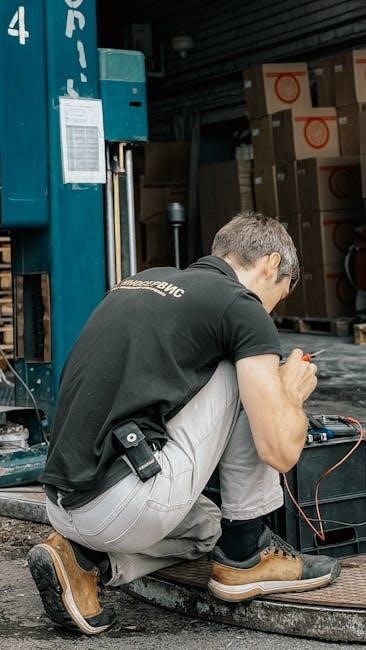
The ability to precisely position pallets is another significant advantage. Operators have direct control over movement, enabling accurate placement and retrieval without the need for complex steering or programming. Furthermore, manual pallet trucks require no charging or refueling, offering uninterrupted operation and the freedom to use them in various locations without infrastructure constraints. Their lightweight construction also contributes to their ease of handling and adaptability.

Disadvantages of Manual Pallet Lifters
Manual pallet lifters require significant physical effort, have limited load capacities (typically up to 5,500 pounds), and are best suited for short-distance transport;
Limited Load Capacity
Manual pallet trucks, while versatile, inherently possess limitations regarding the weight they can safely handle. Generally, these units are rated for loads reaching up to approximately 5,500 pounds. However, exceeding this capacity, or attempting to move exceptionally heavy pallets, can present significant challenges and compromise operational safety.
The manual nature of these lifters means the operator’s physical strength doesn’t augment the lifting capability. Consequently, heavier loads become increasingly difficult to maneuver, potentially leading to instability and increased risk of accidents. Furthermore, uneven weight distribution on the pallet itself can exacerbate these issues, making it crucial to ensure loads are properly balanced before attempting to lift or move them.
For operations routinely dealing with pallets exceeding the standard weight limit, exploring powered alternatives – such as electric pallet jacks or forklifts – becomes a necessity to maintain efficiency and prioritize worker safety. Relying on manual lifters beyond their intended capacity is not only inefficient but also poses a considerable hazard.
Physical Effort Required
Manual pallet lifters, by their very design, demand a significant degree of physical exertion from the operator. Unlike their powered counterparts, these tools rely entirely on human muscle power to lift, lower, and maneuver loaded pallets. This necessitates considerable strength and stamina, particularly when dealing with heavier loads or navigating uneven surfaces.

The operation involves pumping a handle to raise the forks, and then pushing or pulling the pallet jack to move it. Repeated pumping and steering can be physically taxing over extended periods, potentially leading to operator fatigue and increasing the risk of strain injuries. This is especially true in environments requiring frequent pallet movements or long distances.
Therefore, it’s crucial to consider the physical capabilities of the workforce and implement strategies to mitigate fatigue, such as job rotation or providing assistance for particularly demanding tasks. Prioritizing ergonomic practices and proper lifting techniques is also essential to minimize the risk of musculoskeletal disorders.
Suitability for Short Distances
Manual pallet lifters excel in scenarios demanding short-distance pallet transportation within confined spaces. Their inherent design and operational mechanics make them ideally suited for tasks like moving goods within a warehouse aisle, from a loading dock to a storage area, or across a retail floor. They are remarkably efficient for navigating tight corners and maneuvering in areas inaccessible to larger, powered equipment.
However, their reliance on manual power significantly limits their practicality for covering substantial distances. The physical effort required to push or pull a loaded pallet jack over longer stretches quickly becomes unsustainable, impacting productivity and increasing operator fatigue.
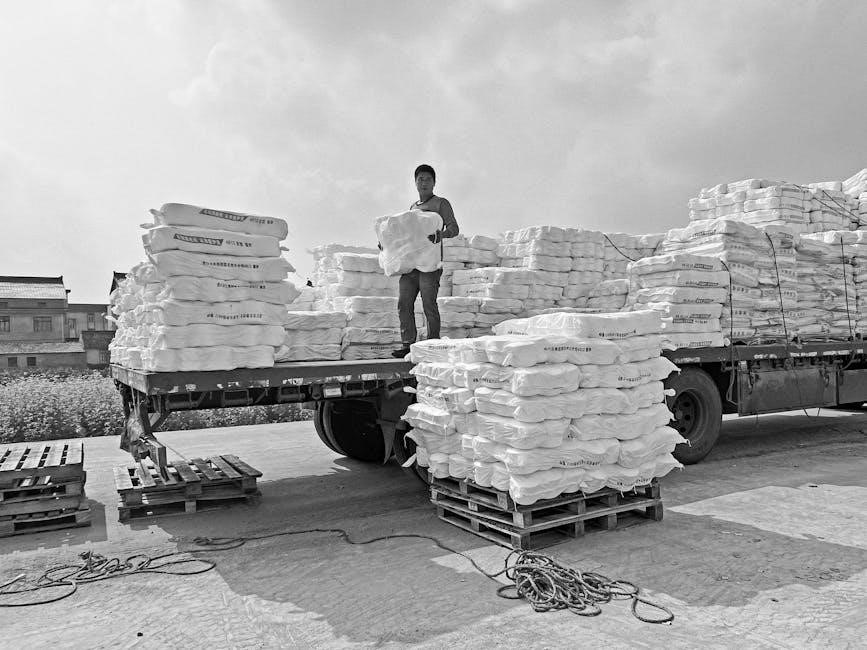
For larger facilities or operations involving extensive transport needs, powered pallet jacks or forklifts are far more appropriate. Manual lifters truly shine when focused on localized movements, optimizing workflow in specific, limited-range applications.

Applications of Manual Pallet Lifters
Manual pallet lifters are widely utilized in warehouses, retail settings, and small businesses for efficient, short-distance pallet movement and stacking operations.
Warehouses and Storage Facilities
Manual pallet lifters are indispensable tools within warehouses and storage facilities, facilitating the efficient movement of goods across relatively short distances. Their simplicity and maneuverability make them ideal for navigating congested aisles and loading/unloading operations. Unlike powered alternatives, manual pallet jacks require no charging or fuel, ensuring continuous operation without interruption.
These lifters excel in tasks like consolidating pallets, transporting materials from receiving docks to storage locations, and preparing orders for shipment. While limited in load capacity compared to forklifts, manual pallet lifters effectively handle the majority of palletized goods commonly found in warehousing environments. Their lightweight design and ease of use contribute to increased productivity and reduced worker fatigue during repetitive tasks. Regular use streamlines workflow and optimizes space utilization within the facility.
Retail Environments
Manual pallet lifters play a crucial role in retail environments, particularly in backroom operations and during stock replenishment. Their compact size and ease of maneuverability allow staff to efficiently move pallets of merchandise from delivery trucks to storage areas, and then onto the sales floor. Unlike larger, powered equipment, manual pallet jacks don’t require extensive space, making them suitable for smaller retail backrooms.
These lifters are especially valuable for handling frequent, smaller deliveries common in retail. They facilitate quick unloading and restocking, minimizing disruption to customer service. The low initial cost and minimal maintenance requirements align well with the budgetary constraints often faced by retail businesses. Their simple operation requires minimal training, enabling staff to quickly become proficient in their use, improving overall efficiency and stock availability.
Small-Scale Operations
Manual pallet lifters are an ideal solution for small-scale operations, such as independent businesses, workshops, and smaller distribution centers, where the investment in expensive, automated equipment isn’t justifiable. Their affordability and simplicity make them accessible to businesses with limited capital and space. These lifters excel in environments requiring infrequent pallet movement or handling lighter loads, offering a practical alternative to more complex systems.
The lightweight design and easy operation of manual pallet jacks allow for flexible use within confined spaces, common in smaller facilities. They eliminate the need for specialized training, enabling employees to quickly adapt to their use. Furthermore, the minimal maintenance requirements reduce downtime and associated costs, making them a reliable and cost-effective material handling solution for businesses prioritizing practicality and efficiency.

Safety Considerations When Using Manual Pallet Lifters
Prioritize proper training, adhere to load limits, follow safe procedures, and conduct regular inspections to ensure safe and efficient operation of manual pallet lifters.
Proper Training and Certification
Comprehensive training is paramount for all personnel operating manual pallet lifters. Operators must understand the equipment’s capabilities, limitations, and potential hazards. Training programs should cover pre-operational checks, safe lifting and lowering techniques, proper maneuvering procedures, and emergency protocols. Certification demonstrates competency and adherence to safety standards, minimizing the risk of accidents and injuries.
Effective training emphasizes load weight limits and distribution, ensuring operators don’t exceed the lifter’s capacity. It also highlights the importance of maintaining a stable load and avoiding uneven surfaces. Regular refresher courses are crucial to reinforce safe practices and update operators on any new safety guidelines or equipment modifications. A well-trained workforce significantly contributes to a safer and more productive work environment, reducing potential liabilities and operational disruptions;
Load Weight Limits and Distribution
Understanding load capacity is critical when using manual pallet lifters; exceeding the specified limit compromises safety and can cause equipment failure. Most manual pallet trucks handle up to 5,500 pounds, but this varies by model. Proper load distribution is equally important – ensure the weight is evenly spread across the forks to maintain stability during transport. Unevenly distributed loads can lead to tipping or loss of control.
Operators must always check the pallet lifter’s nameplate for its maximum load capacity before each use. They should also visually inspect the load to assess its weight and stability. Avoid lifting loads that appear unbalanced or are improperly secured. Regularly inspecting the pallet and load for damage is also essential. Ignoring these precautions can result in serious accidents, injuries, and damage to goods or equipment.
Safe Operating Procedures
Prior to operation, always inspect the manual pallet lifter for any damage, ensuring forks are in good condition and wheels move freely. Clear the path of obstructions and personnel before lifting or moving a load. When pumping the handle, use a smooth, controlled motion, avoiding jerky movements. Maintain a firm grip and keep your back straight to prevent strain.

During transport, walk alongside the pallet lifter, never ride on it. Be mindful of your surroundings and slow down when turning or navigating ramps. Avoid sudden stops or changes in direction. When lowering a load, do so slowly and carefully, ensuring the pallet is fully supported before releasing the handle. Never exceed the recommended operating speed and always follow established safety protocols within your workplace.
Regular Inspection and Maintenance
Consistent inspection is crucial for safe operation; regularly check for bent forks, loose chains, and worn wheel bearings. Lubricate moving parts – wheels, hinges, and the lifting mechanism – to ensure smooth functionality and prevent corrosion. Inspect hydraulic fluid levels (if applicable) and address any leaks promptly. Examine the handle and ensure it operates correctly, engaging and disengaging smoothly.
Preventative maintenance extends the lifespan of your manual pallet lifter. Tighten any loose bolts or fasteners. Clean the lifter regularly to remove dirt and debris. If wheels become damaged, replace them immediately. Address any unusual noises or operational difficulties promptly; ignoring these can lead to more significant and costly repairs. Keep a maintenance log to track inspections and repairs, ensuring a consistent upkeep schedule.